A reader asked:What Actually Makes Things Stick
Why hobbies fade and how to make them stick

The Hidden Architecture of Abandoned Hobbies (And What Actually Makes Things Stick)
A reader recently asked why hobbies collapse so predictably—”why guitar lessons feel essential on Tuesday and impossible by Thursday. What Actually Makes hobbies Stick?”
Even though I am certified to treat all aspect of mental health across the spectrum- I specialized neurodivergence care for undiagnosed high functional and preforming women and girls.
Here’s what most advice gets wrong: The problem with ADHD and hobby sustainability and completion isn’t willpower. It’s not discipline or “just sticking with it” (that forced joy actually accelerates the collapse). The real issue? You’re unconsciously treating hobbies as identity auditions—trying out different versions of who you could be instead of exploring what you actually enjoy.
Okay! Please hear me out.
The Pattern Beneath the Pattern
For many neurodivergent people, each new interest operates as a low-stakes experiment in becoming someone else. Not consciously—but watch what happens in your mind when you discover rock climbing or watercolor painting.
You don’t just imagine the activity. You imagine the person who does that activity. Calm. Accomplished. Finally regulated. The hobby becomes a Trojan horse for self-transformation. Seriously!
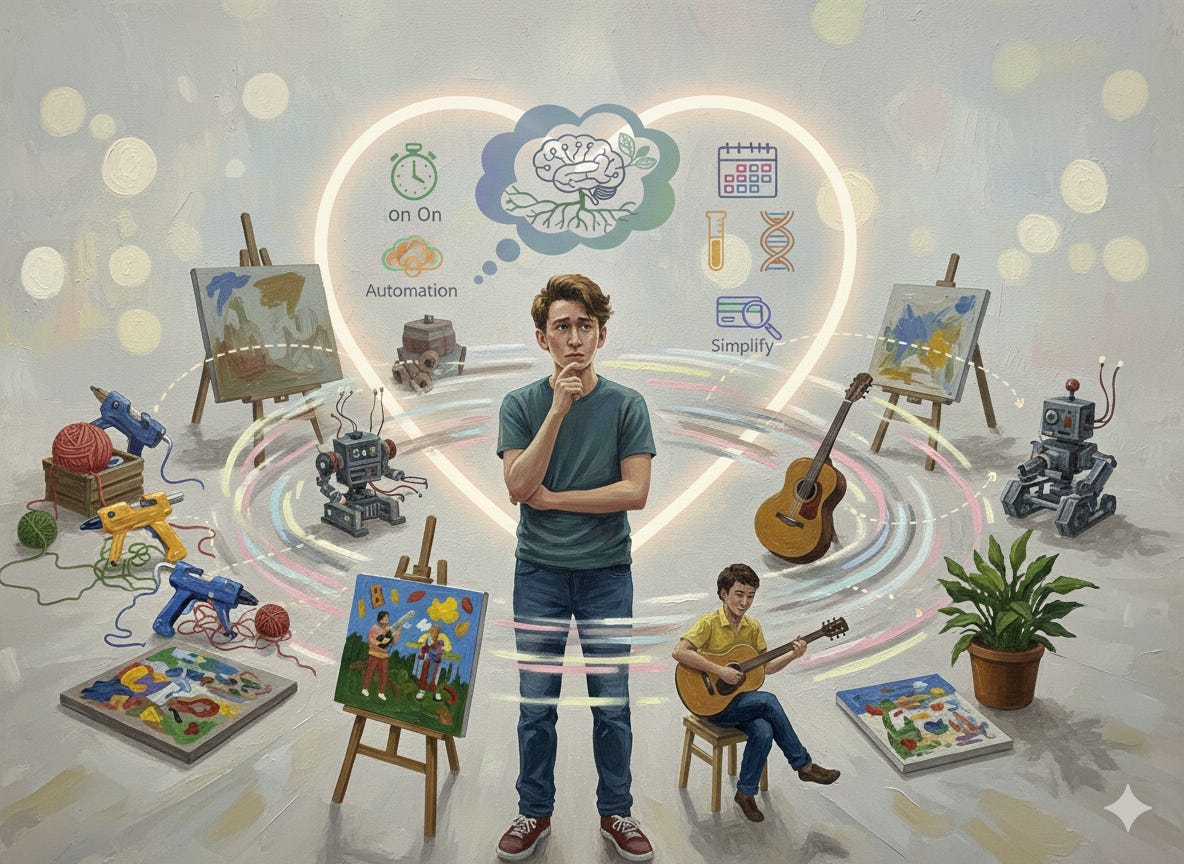
This creates a neurological trap: your brain releases dopamine for the imagined identity, not the actual activity. Because your brain is so highly creative and imaginative—the very reason many neurodivergent people become highly exceptionally good at many hobbies—it also comes at a cost.
When fantasy meets friction with reality—when you have to watch beginner tutorials, struggle through fundamentals, slow down for context and details, or practice imperfectly—the gap between vision and reality crashes your motivation system. It can feel like falling flat on your face. And because rejection sensitivity is common in neurodivergent brains, that fall hits hard.
The interest wasn’t fake. But it was never really about pottery, watercolors, or hiking. It was about escaping who you currently are.
Why the Middle Always Breaks
There’s a specific moment when hobbies die—and it’s predictable.
It happens when the activity transitions from stimulation-that action potential though to start something new to maintenance. When novelty ends and repetition begins. When you move from consuming information to producing incremental results.
For ADHD wiring specifically, this is where executive function demands spike: now you need planning, pacing, boredom tolerance, and delayed gratification. The same brain that excels at hyperfocus during the research or inspiration phase can hit a wall during the practice phase. That “hitting the wall” can sometimes be cushioned or minimized in brains with AuDHD wiring, which may thrive in maintaining momentum from the middle of a task to completion.
If you internalized years of “you just need to try harder” messaging, this neurological bottleneck reads as moral failure—self-judgment central, with all the arrows pointing at you—asking you to dig countless pits and bury your head in shame. You’re not just abandoning hobbies; you’re abandoning the evidence that you still can’t be the person you think you’re supposed to be.
That shame? It’s grief and self abandonment wearing a disguise.
What Actually Changes the Pattern
Stop trying to fix your follow-through. Start designing for your actual nervous system.
1. Audit your real motivation (before you start)
Before investing, ask four questions that expose identity-seeking:
“If no one ever knew I did this, would I still want to do it?”
“Am I drawn to the activity, or to posting about the activity?”
“Does this interest spark curiosity—or solve anxiety?”
“Do I truly need this specific hobby, and how does it align with my authentic self and long-term goals?”
This distinguishes genuine interest from disguised regulation attempts.
2. Prototype before you commit
Use what I call the “trial by inconvenience” test:
Do it badly, on purpose, for one week
Use borrowed equipment or free resources
Tell no one—remove the social reward variable
If you return to it when it’s clumsy, unimpressive, and private, you’ve found real interest. If not, you’ve saved yourself from another shame spiral.
3. Redefine completion as insight, not achievement
Instead of “finish the course,” aim for: “Discover whether this activity regulates or depletes me.”
That’s a completable goal. You can succeed in two sessions. This removes the identity stakes and converts hobbies from tests into data.
4. Externalize the middle
The follow-through gap needs non-motivational scaffolding:
Scheduled friction reduction: Pre-decide your practice time when you’re excited, so your future depleted self doesn’t have to choose
Body doubling: Work alongside someone (in-person or virtual) to borrow their active nervous system
Micro-sessions: Ten minutes counts. This preserves the relationship without demanding performance.
5. Create purposeful endings
When interest fades, conduct a “hobby autopsy”:
What did this teach me about my nervous system?
What was I hoping this would fix about my life?
What parts did I actually enjoy versus perform?
Write it down. This single act transforms abandonment into learning and releases the emotional debt of unfinished projects. Think of it as gentle guidance for laying misaligned hobbies to rest—without shame, without guilt, but with renewed clarity for what comes next. Yes, another hobby buried. But at least you’ve learned something. And if no learning emerges during this critical closing process? That’s your signal to return to the beginning: audit your real motives before starting anything new.
6. Separate regulation from recreation
Here’s the insight that changes everything: If you need hobbies to feel okay, they’re not hobbies—they’re unprescribed medication.
And unregulated self-medication always fails eventually.
You’re not “bad at hobbies.” You’re using hobbies to solve a regulation problem—asking painting or running or woodworking to stabilize what therapy, movement, medication, or nervous system support should be addressing. When the hobby inevitably can’t hold that weight, you internalize it as personal failure instead of recognizing it as the wrong tool for the job.
Stop medicating with interests. Build regulation first. Then hobbies become what they were always meant to be: optional, enjoyable, low-stakes.
Build regulatory practices separately: walking, specific playlists, sensory tools, medication if appropriate. When your baseline stability doesn’t depend on your hobby success, you can engage with interests playfully instead of desperately.
Learn how to regulate first, then recreate with sustainability
The Bigger Reframe
You’re not “bad at hobbies.” You’re using hobbies to solve problems they weren’t designed to fix.
Interest-cycling isn’t a character flaw—it’s often undiagnosed nervous system dysregulation attempting to self-correct through novelty. The solution isn’t better hobbies. It’s better regulation tools underneath the hobbies.
When you stop asking activities to transform you and start asking them to simply interest you, commitment becomes lighter. Not because you’ve changed who you are—but because you’ve stopped requiring yourself to.
Different nervous systems need different infrastructure. With the right support, you can build a life where follow-through doesn’t require burning down your self-worth.
If this resonates, you don’t need more discipline. You need someone who understands the architecture.
For guidance about your individual health needs, be sure to establish a proper relationship with a clinician or seek support from your own medical provider. Feel free to consult with us via our sister company -At Frederick Integrative Metabolic Psychiatry and Counseling
You are fearfully and wonderfully made!
Umu Coomber, MSN, ARNP-PMHNP,
Board Certified Holistic Integrative, Metabolic, and Nutritional
Psychiatry Mental Health Nurse Practitioner
Specialized neurodivergence care for undiagnosed high functional and preforming women and girls.